
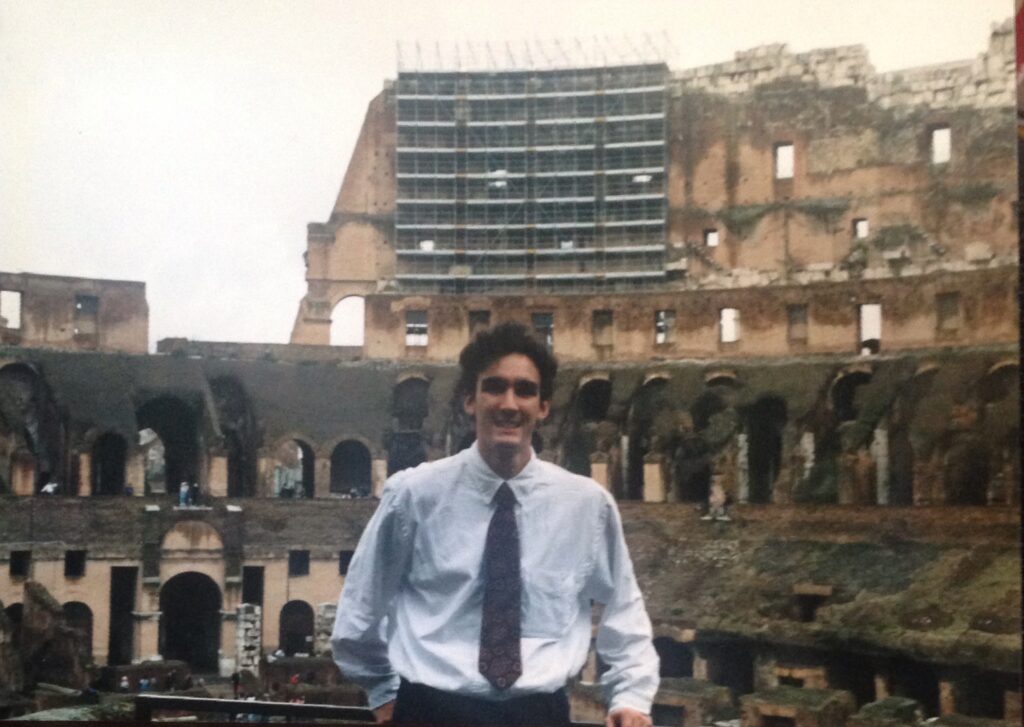
This month I am making my fourth and fifth visits to Rome. I was blessed to visit in 1997 and 2000 during and just after college, and then it was twenty-three years until I visited again in 2023. Now, this year, I am visiting again, for two days at the start of this month, and for five days at the end. A lot has changed across the span of time between my visits — mostly the differences are on my side, and not so much on the side of the eternal city. My own changes, of age, of religious vocation, and of ordination to the priesthood, just to name a few, have certainly affected what I went to see and how I saw what I saw.
One Church I had never visited until this month is Sant’ Agostino, the Church of the Augustinian friars, of which our current Pope is a member. I love St. Augustine, but this time I was particularly seeking the bones of his mother, St. Monica. A friend had mentioned to me long ago how much she loved praying at Monica’s tomb, and then in the summer someone had reminded me that Monica was buried just around the corner from where I would be staying.
I found myself kneeling there on Sept. 4, just a few short days after Monica’s feast day, and lifting up all sorts of prayers, but especially asking for her intercession for my students. She, whose tears were heard on behalf of her son, she might lift up to God these young men and women whose journeys have ends that I cannot foresee.
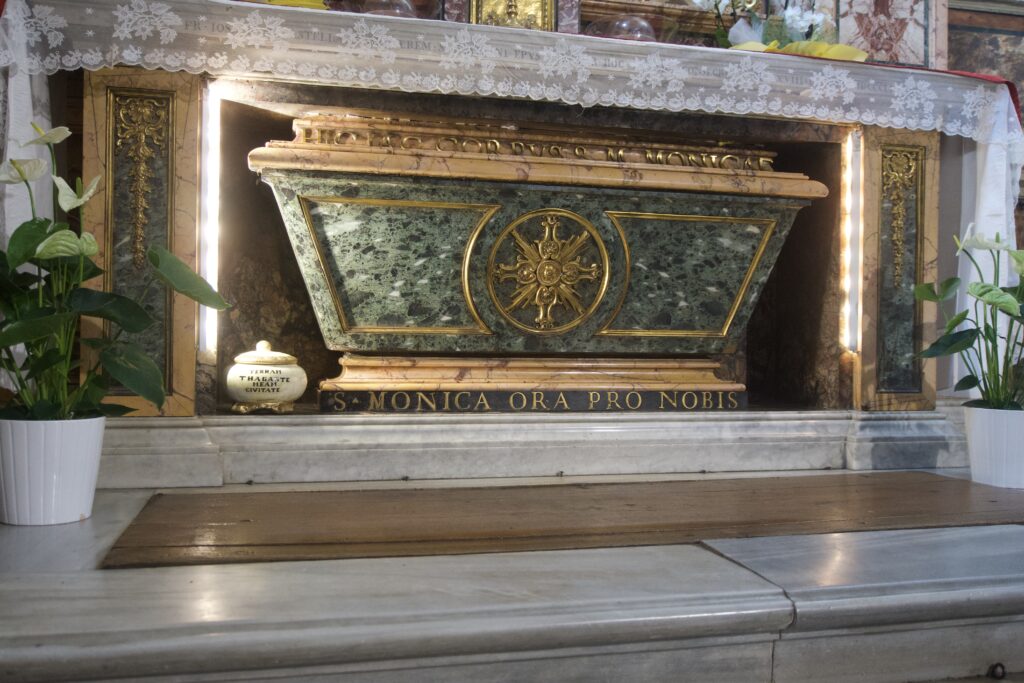
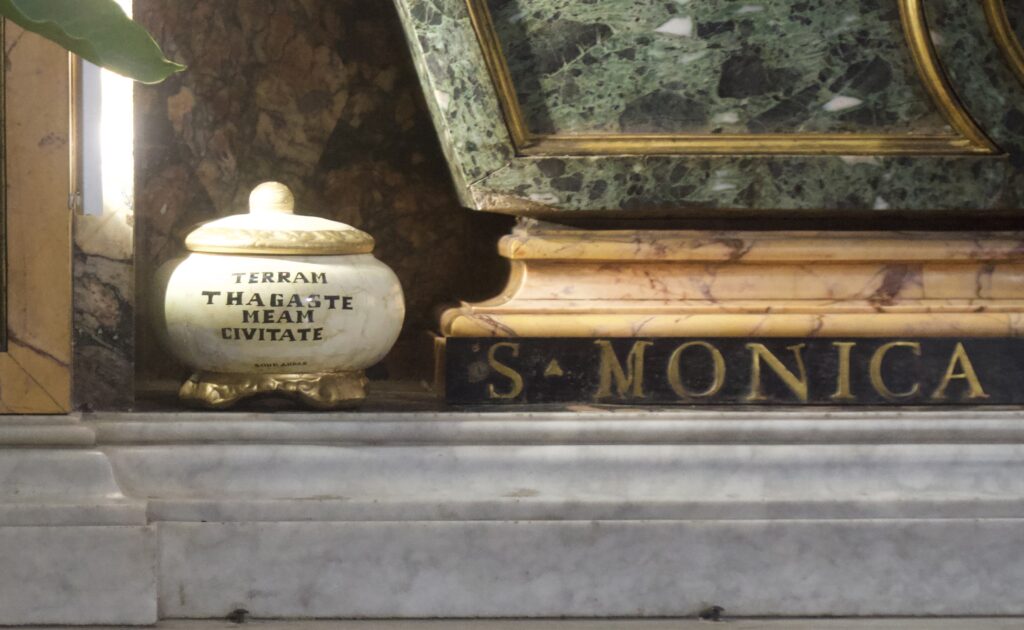
According to her son’s account, as she was dying in Italy, she did not see any need to be buried back in Africa where she had been born and raised. The only thing she asked was that her son would remember her at the altar of the Lord. It was all the more touching that her request to be remembered there was fulfilled in a literal way, since her bones now sit below a beautiful altar in the Church.1 Even so, in addition to this, she lies next to a jar of earth from her North African town, Thagaste. Her body did not return to the soil of Africa, but the soil of Africa was brought to her.
- “Nor did she care if she had a tomb in her homeland. On that she gave us no instruction; she desired only that she might be remembered at your altar which she had attended every day without fail, where she knew that what is distributed is the holy victim who ‘abolished the account of debts which was reckoned against us’ (Col. 2: 14).” Augustine, Confessions, 9.13.36, trans. Chadwick. ↩︎