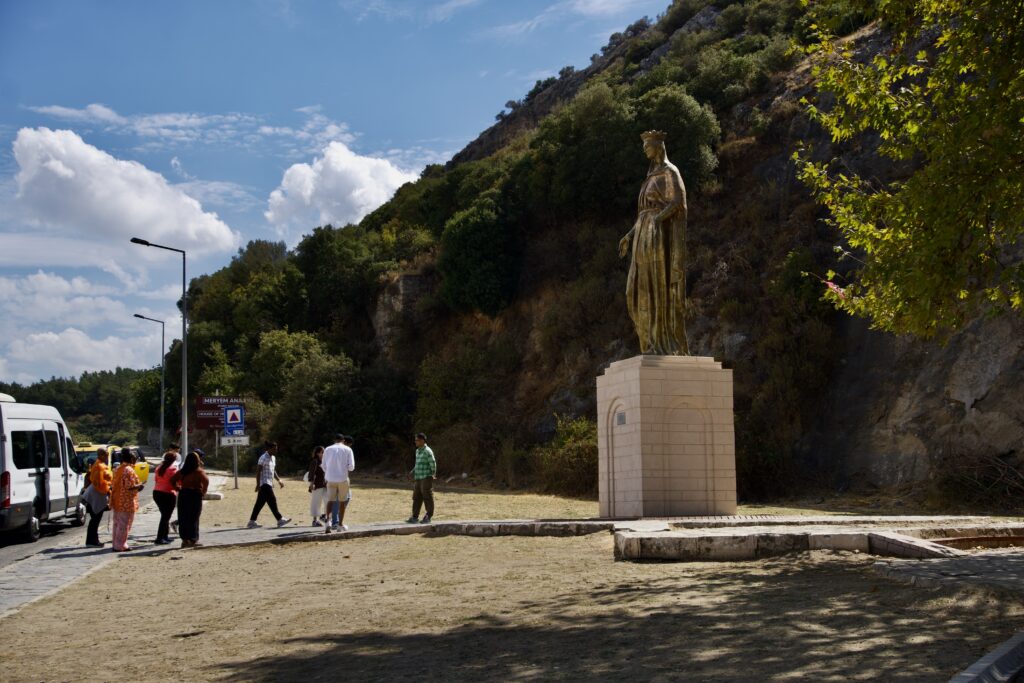
On September 16, my day began and ended with Mary. I began the day outisde the town of Selçuk, Türkiye, the site of ancient Ephesus, at the top of the “Nightingale Hill,” as the taxi driver told me it was called in Turkish. We swept past a gigantic gold statue of Mary, the Mother of God: “Your government built that,” he said, with a smile.
The U.S. government did not, in fact, build that.
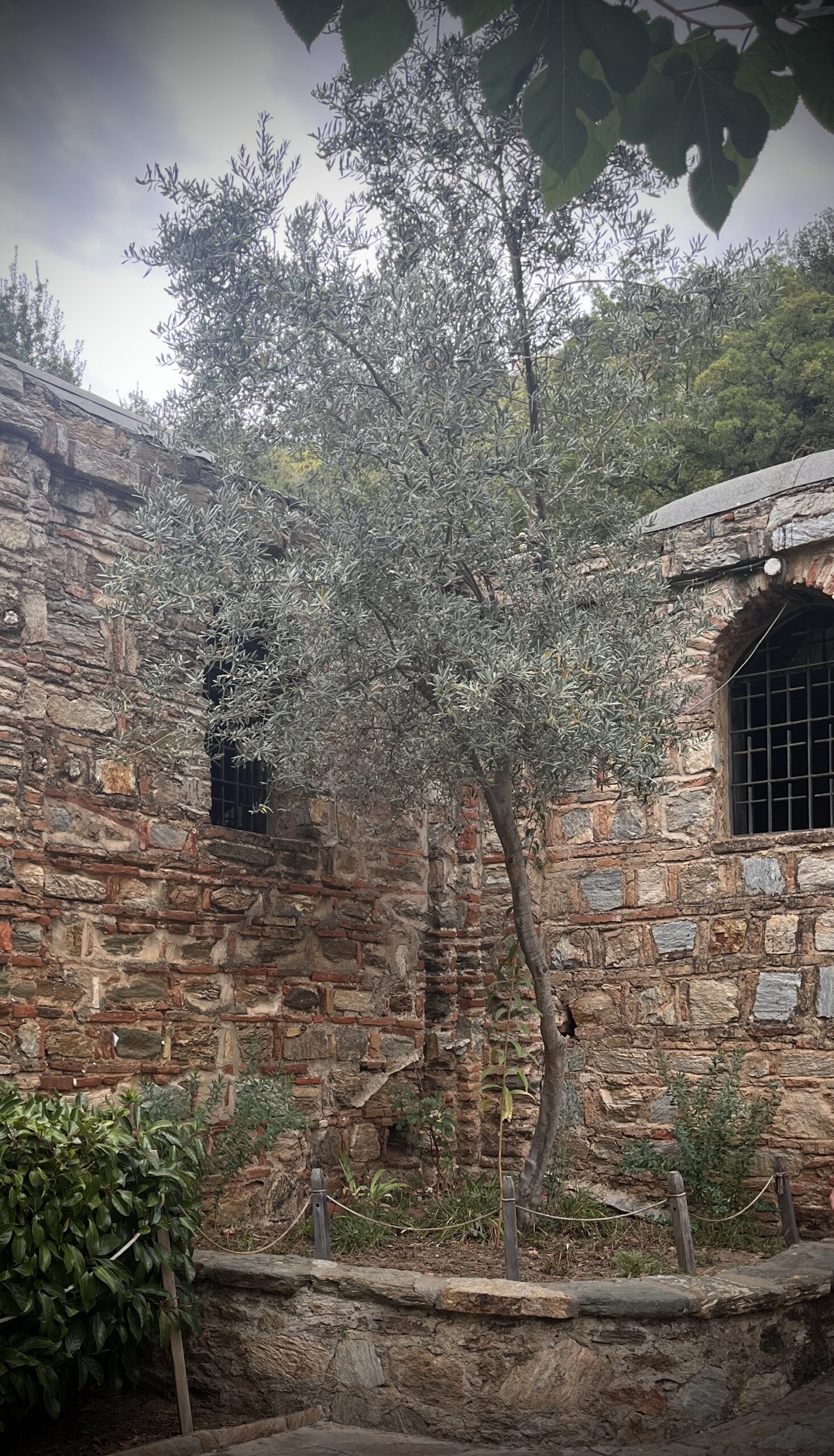
My first destination was Meryem Ana Evi, the house of the Virgin Mary, where I was to concelebrate the 10:30am mass. I sent a text message to let the Franciscans know I had arrived, and I sat outside the house of the Virgin, facing a lovely small olive tree.
The wall of the House of Mary, and the olive tree.
A very kind Italian sister introduced herself. “Come,” she said, once she confirmed I was a priest, “You can pray inside.” I was swept along and tucked in a corner as a seemingly endless procession of pilgrims filed past. There, in a building whose core is claimed to go back to the first century, I sat and prayed the Rosary.
Here in Egypt I have been taking time for review. We have been asked as part of tertianship to review our entire lives, in fact. It is an intense and personal journey with God, as one might imagine. But that bigger work allows time to do some smaller reviews, including sharing some more details of my travels in September. So I hope to do a series of posts about those, interspersed with some updates from Alexandria, Egypt, where I am currently.
One of the things that people have been saying to me repeatedly during the leadup to this year of tertianship has been “take lots of pictures.” In our world of media and sensory overload, and in my own self-examination about how much I am seduced by the visual, by the videographic, and by the abstracted that pulls me away from the here and now, I have felt some internal resistance to these people’s admonition: “Take lots of pictures.” I want to find myself in this year becoming more present to myself and to God, and not less. I want to go places to be conscious of God’s Spirit breathing into me and into the Church. I do not want to be thinking about how this photo will look on the web or on someone’s phone or in the future.
But I started to change my mind about “take lots of pictures” when I began to hear it from a couple of new directions. In the first place, I heard it as my friends’ real desire to go with me in a virtual way and to have me share the experience and the grace of these months with them. It was an expression of their love for me and for the gifts that I would experience. They were not wanting to take me away from these experiences but to go with me into them, whenever I would have the occasion to share those graces with them. In a related way, I was talking with a friend who had studied for a summer in Athens many years ago, and he was saying that in his group were a number of people hoping to teach architecture and art history. They took trips around Greece and around Athens very seriously as a chance to build a set of photos and images that would be the foundation of their teaching for decades to come. Thus I began to see ahead of time that my own plans to visit so many ancient sites were a chance to build my own set of images that could be of a quality to induce awe, reverence, excitement, and interest in the topics of the ancient world and of ancient Christianity.
I have always had a great love of photography, thanks to my father’s great interest in it and enjoyment of it as a hobby. Thanks to him I learned to shoot with his manual SLR 35mm film camera and then in college got one of my own. I still treasure so many of the photos I took from that era, and the fundamentals of capturing light have stayed with me.
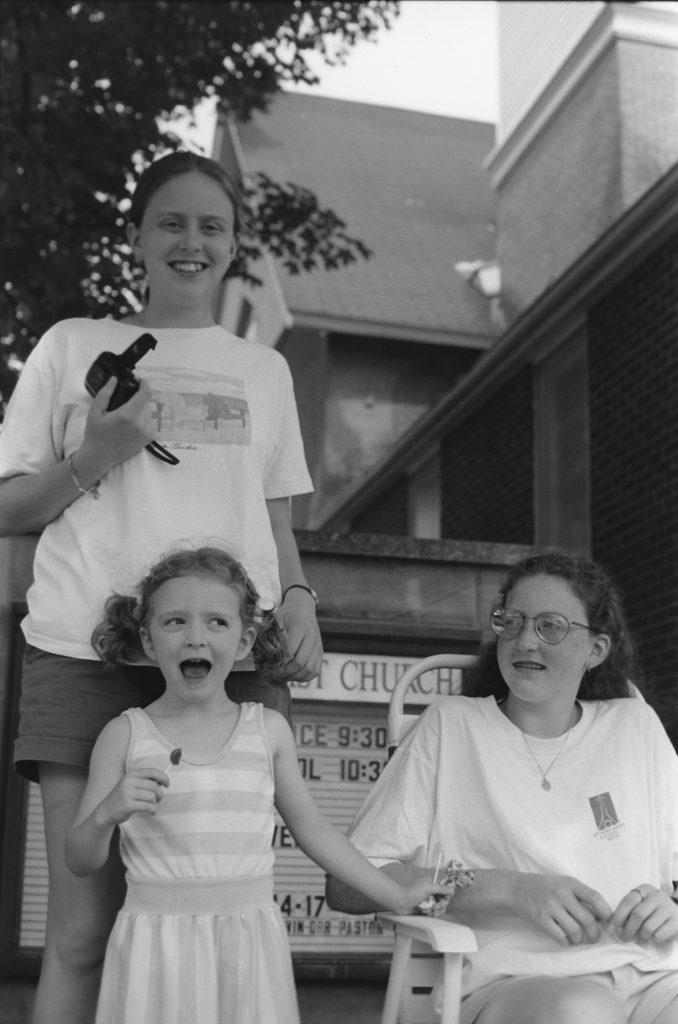
My three sisters at a July 4 parade, probably 1998 or 99. Color had not yet been invented. My sisters might all murder me for posting this.
But in the era of smartphones much of my eye for light went away. The phone did much of that work for me, and though I still enjoyed capturing a particular angle or moment, I was no longer thinking so carefully about what I was seeing and how light was being managed and shaped by these devices. And my era of enjoyment in taking phone photos was short. As Twitter and Facebook collapsed under the weight of monetization I quit almost all of my social media accounts in 2014. The one I kept longest was Instagram. For a few years, it was a very fun place to share photos in a square format within the challenging constraints of smartphone cameras.
But when Instagram moved from a platform to share photos to a platform on which influencers sold things, I was not enjoying it anymore. I quit it around 2016. My family’s photo sharing, and the random texting of photos to friends, became my only outlets for photos.
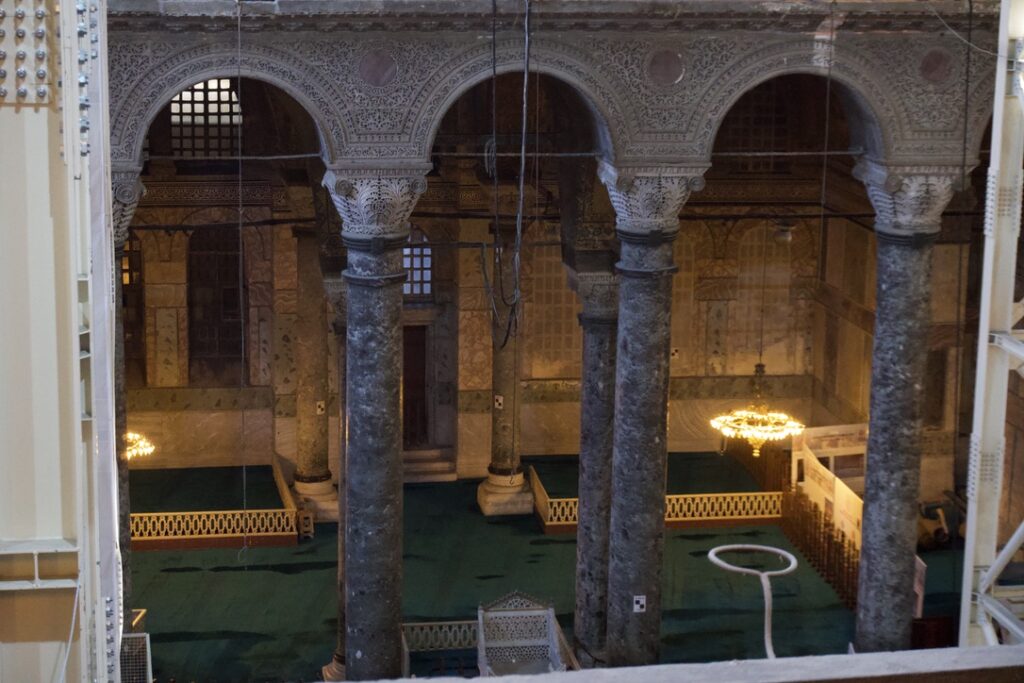
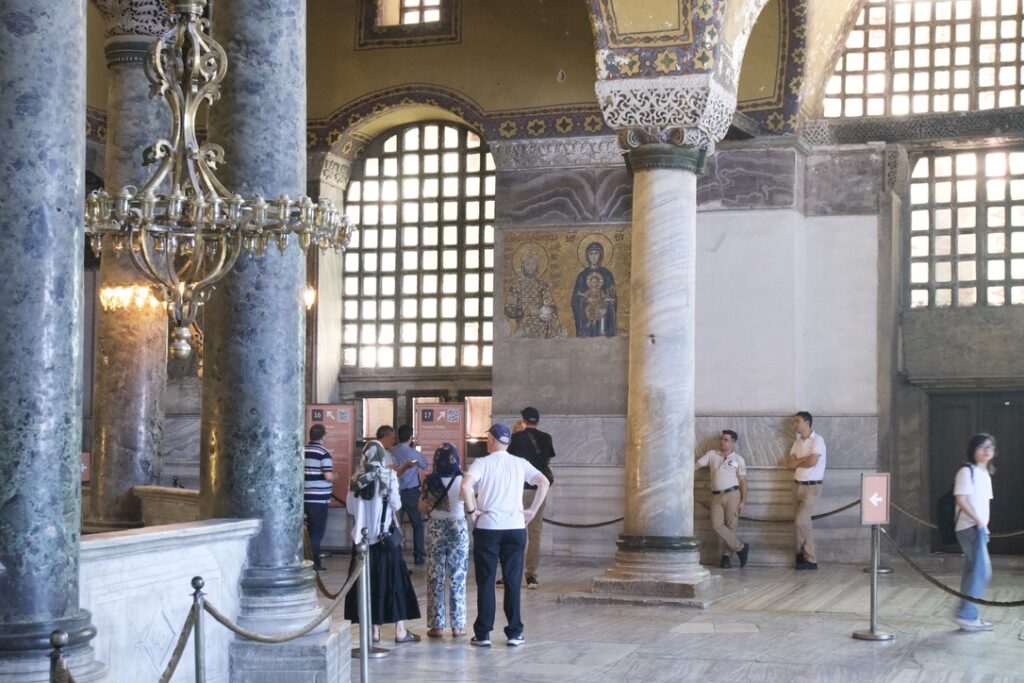
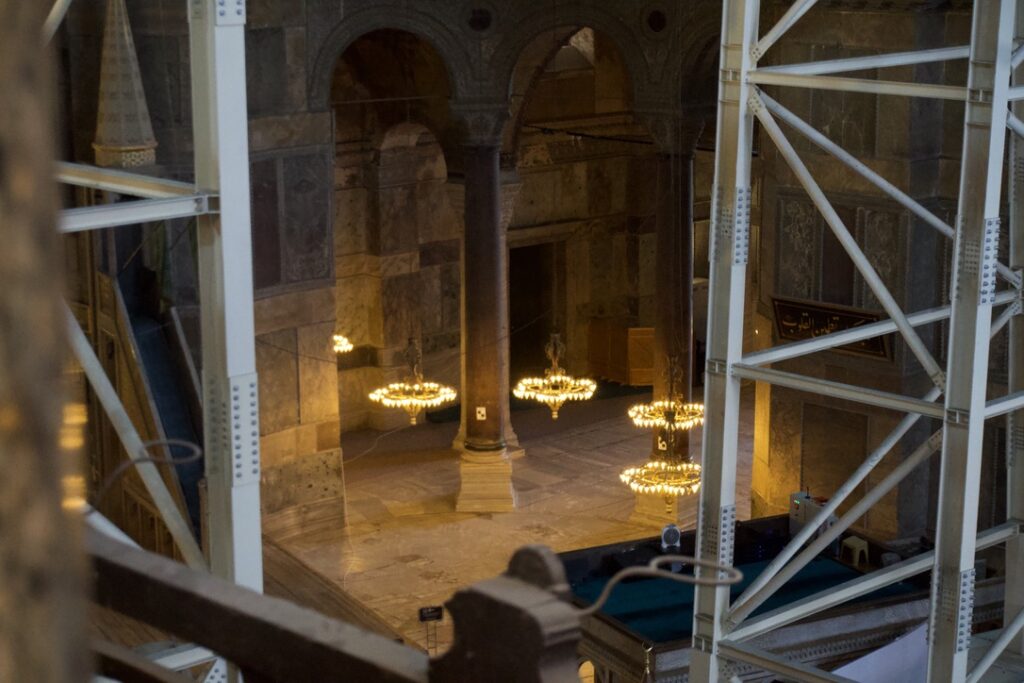
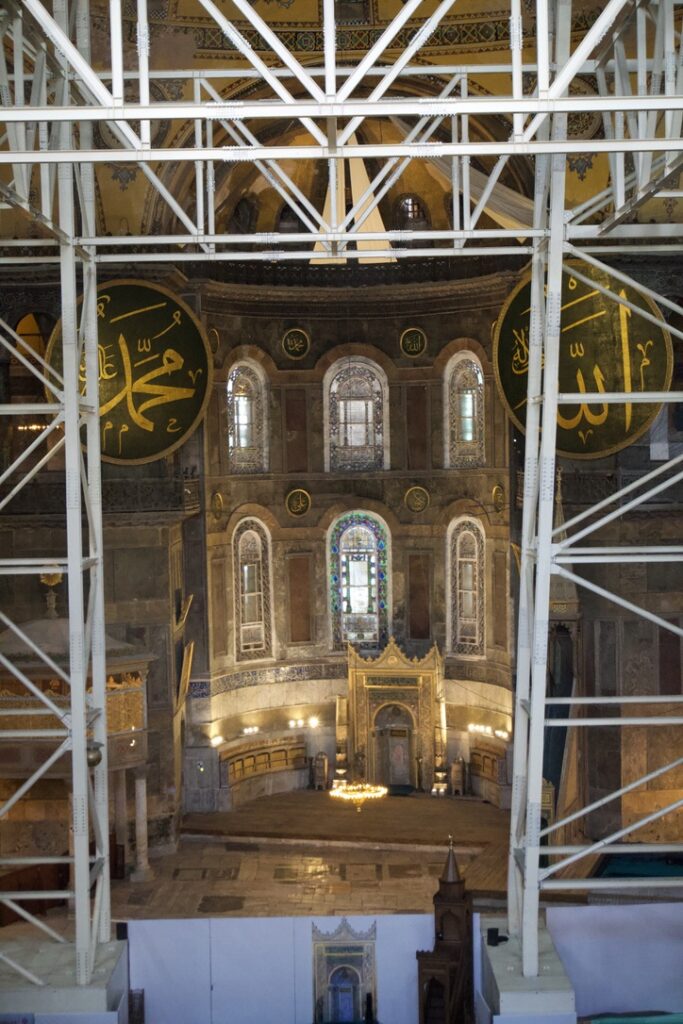
So now, in this year of tertianship, I have been monitoring how I “take lots of photos.” I have been learning slowly how to stay present to the moment and how to think what photos might be moving or effective to share with friends and students. One trick that I discovered was to give myself enough time in a place, especially a Church, that I could walk through it twice. I tried this first in Hagia Sofia, the great ancient Church in Istanbul that is now a mosque. Only part of the building is open to non-Muslim visitors, and I went through it once, taking occasional photos but mostly reading placards and listening to the audio guides and absorbing the beauty. Then, I went back to the start and walked through the massive space another whole time concentrating on photos.
It was difficult to capture the space. There is construction going on in the nave, the main section of the building, and the massive dome is under repair, with the consequence that there is an expanse of cloth blocking one’s view up into the dome. Much of the building’s size was not visible. The first time through the space I was dealing with some disappointment at what seemed inaccessible, such as grandeur, awe, and the traces of the building’s Christian origins. I had to be present to those realities and to let myself feel them the first time through. As I stayed present to those absences, I could also begin to savor the things I really could see. In the remaining Christian elements of the building, I could absorb their beauty and lift my mind to the elements that inspired the heroic artists.
Thus the second time through I could begin to capture some images that connected with the deeper things that I had given myself time to notice on my first walk through.
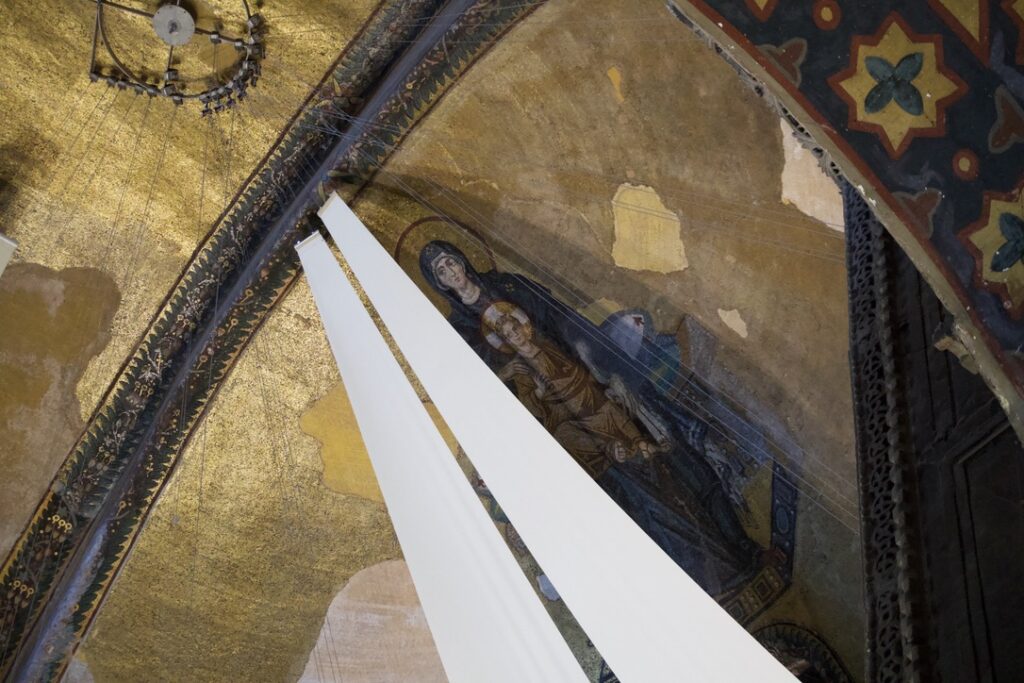
Mary was peeking out from behind a curtain:
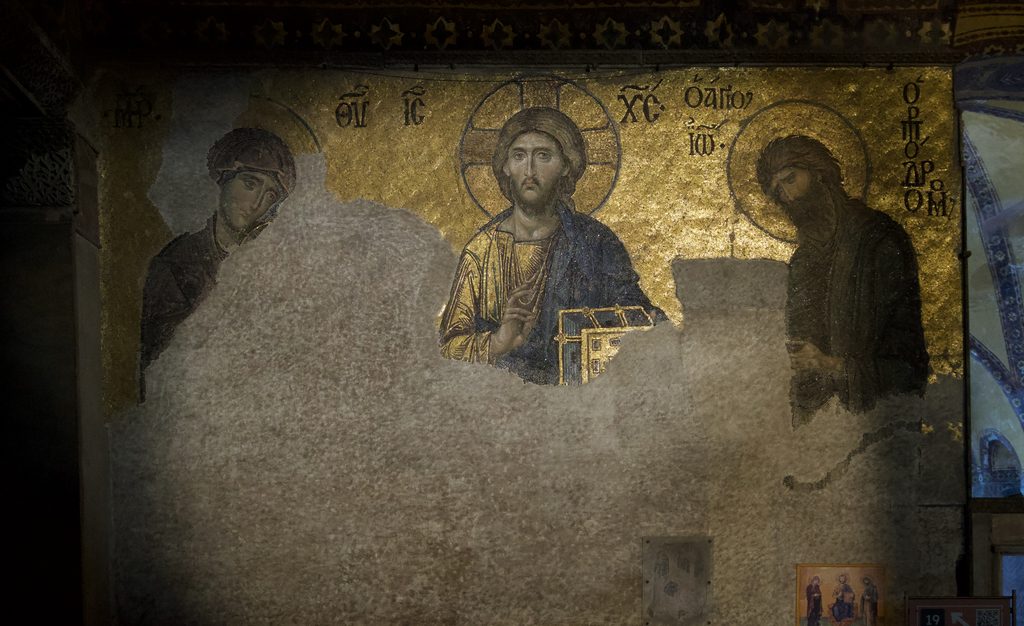
The great image of the deisis leapt from the darkness:
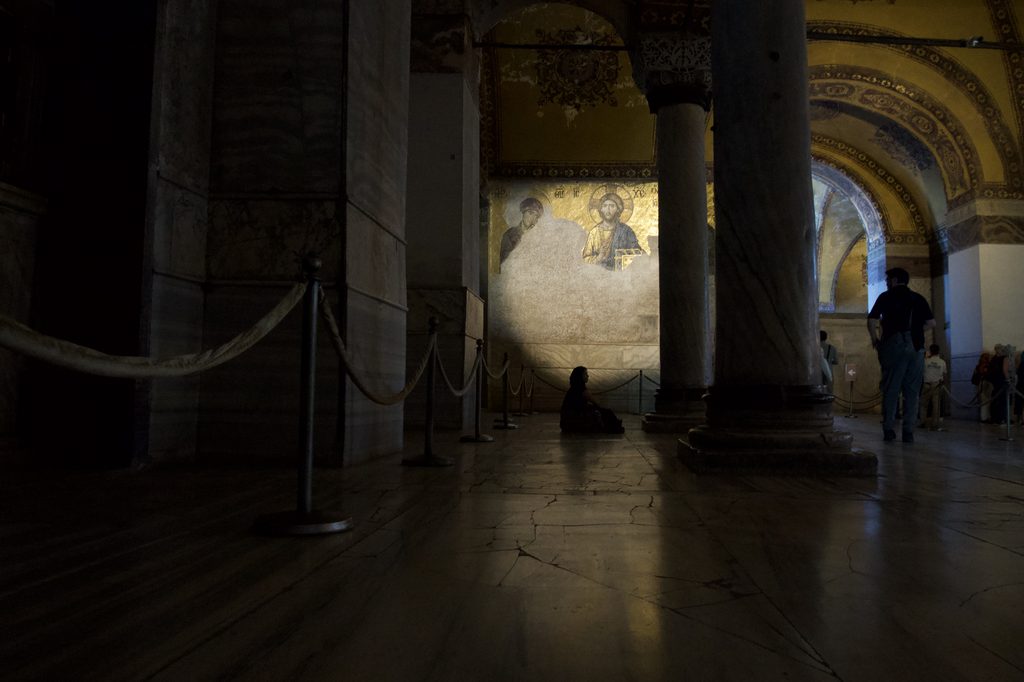
People were moved to pause and stop before the image:
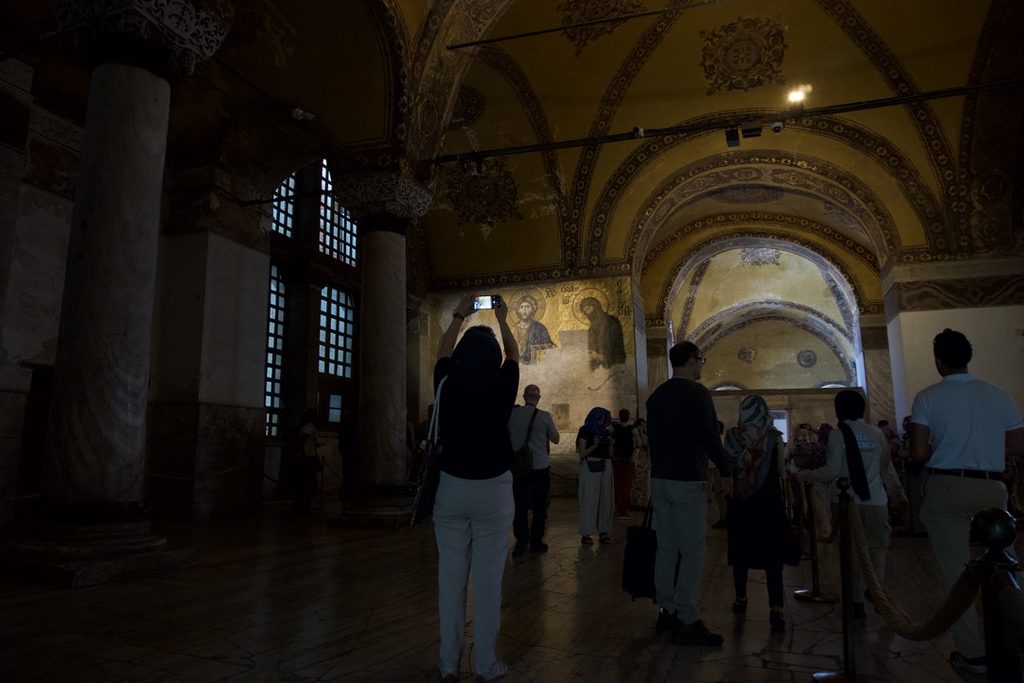
Others were busy capturing memories via electronics:
The visit to the great Hagia Sofia and especially to the deisis offered a first key that has inspired my attempt to take photos since then. Look; absorb; feel; notice; then, go back to the start and take photos that might help you touch the same truths you were perceiving on the first pass.
We have all arrived in Alexandria, Egypt, thanks be to God. Please pray for our group as we grow in spiritual integration and grow towards full incorporation into the Society of Jesus.
Some of the truly profound moments of this journey so far have been in near darkness. Often these moments have also been in places where photos are forbidden, even when they would be next to impossible to take anyway.
The lack of light renders things that I thought I knew appear very different. One of these things has been the experience of icons.
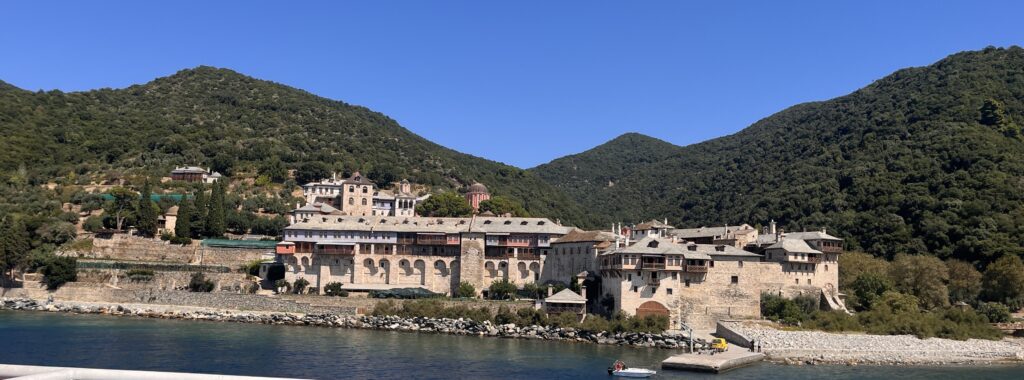
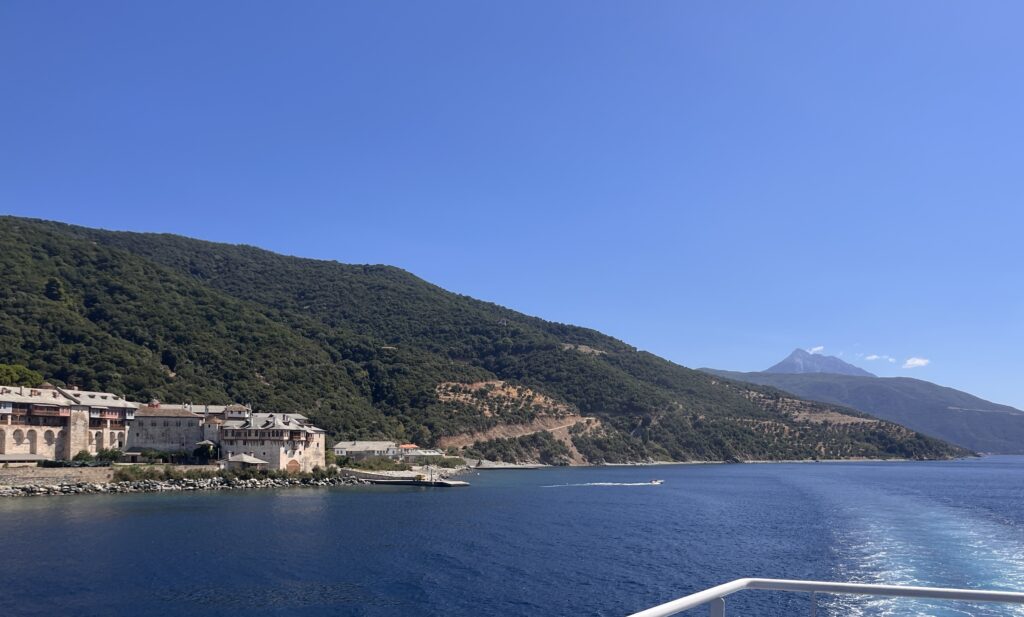
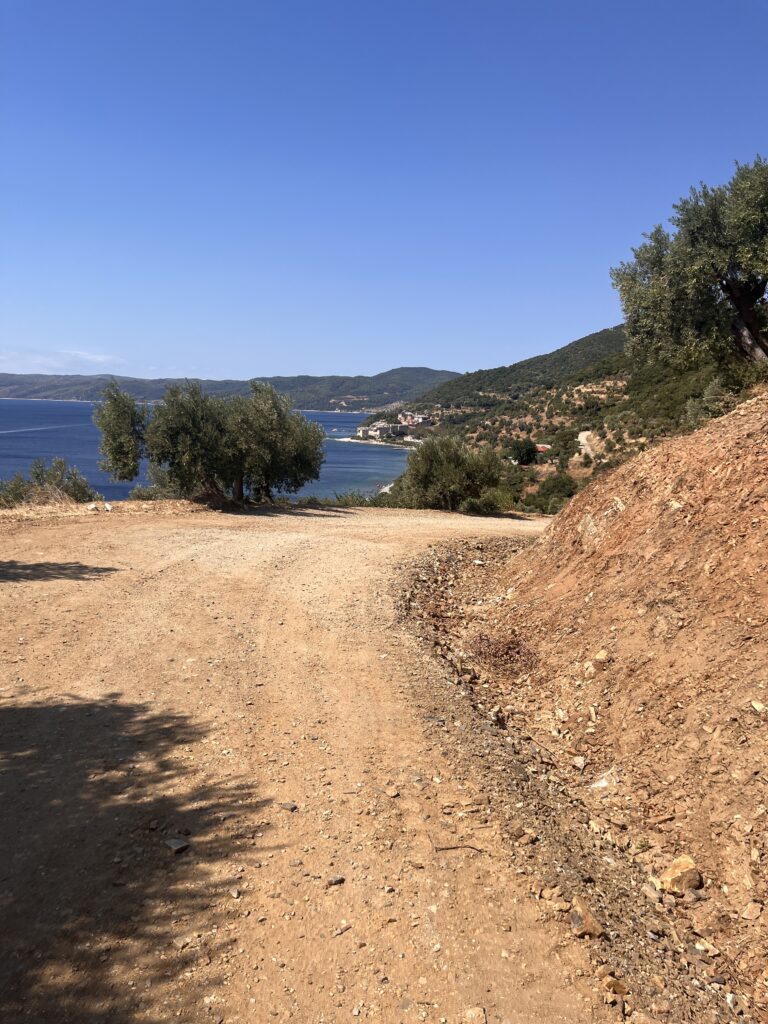
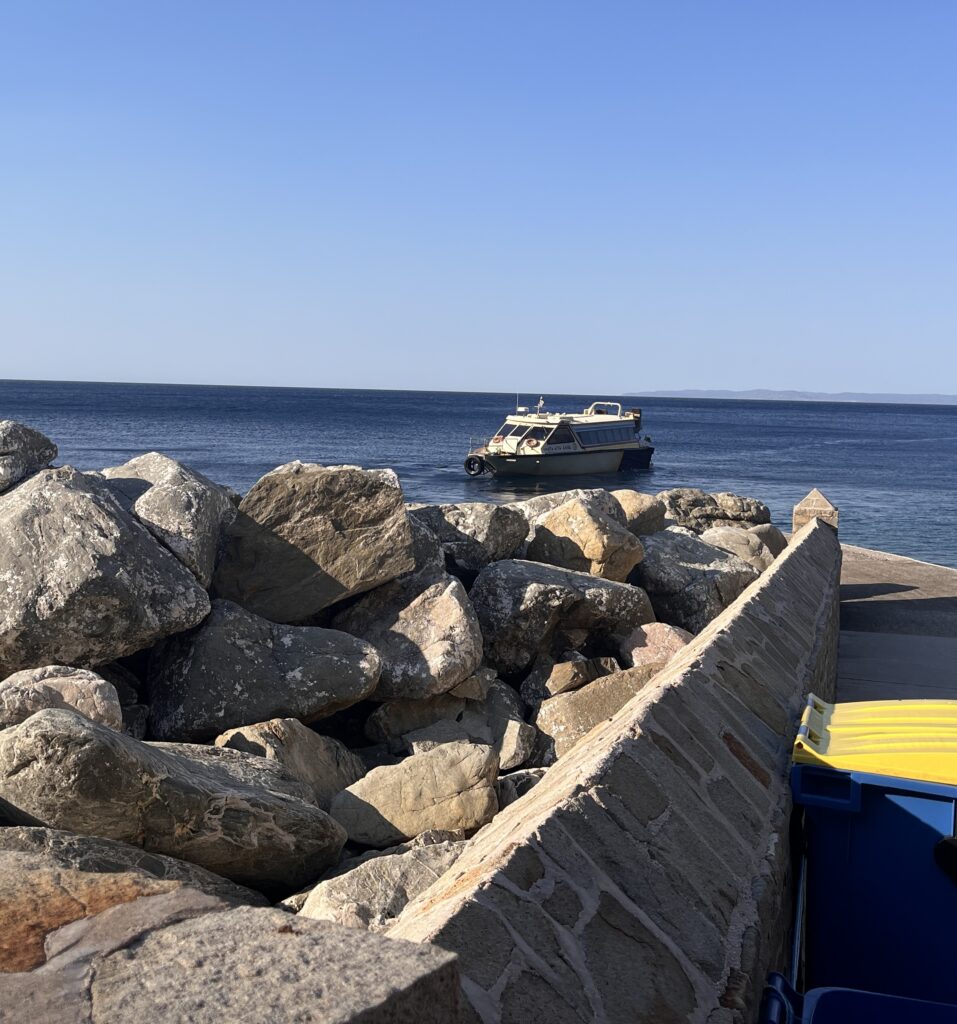
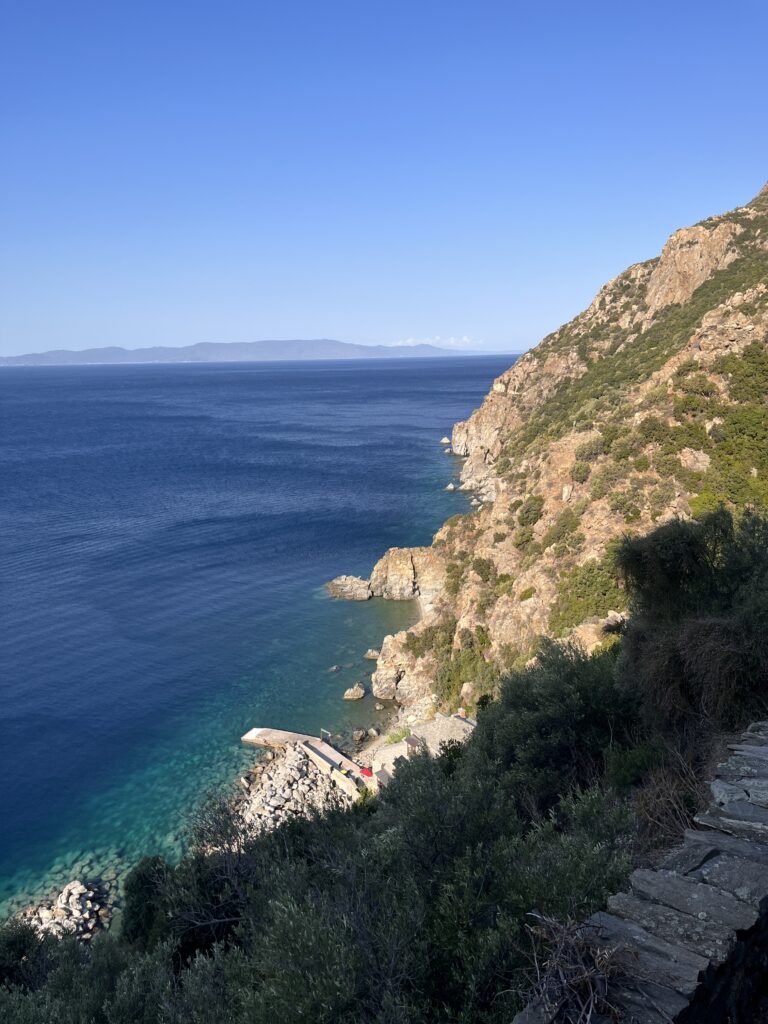
Xenophontos from the seaLooking back at Xenophontos with the holy mountain itself in the distant backgroundWalking the road to Xenophontos from another monastery, Panteleimon
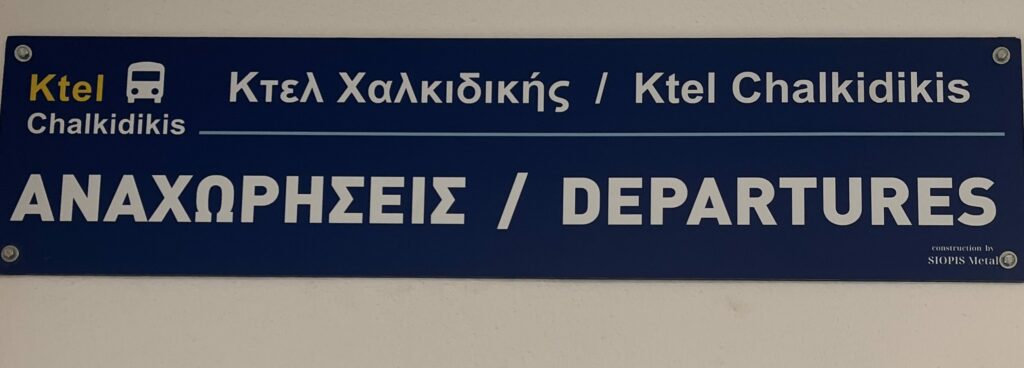
I visited “The Holy Mountain,” Mount Athos, in Greece, with a Jesuit friend of mine over September 7–8. This is one of the great centers of holiness in Eastern Orthodox Christianity, where more than twenty monasteries (and many other smaller gatherings of hermits) exist on a long narrow peninsula that stretches into the Aegean sea. The monasteries welcome only male visitors, and people come from all over the world to pray and join with the monks in the simplicity of their way of life. In the ancient Church this movement away from civilization was called in Greek anachoresis, and it was amusing to see that in modern Greek the same word is used in bus stations and airports.
When I had arrived at Xenophontos monastery the afternoon of Sept 7, I had joined in evening prayer in the large Church, and I had seen nearly every surface covered in icons, radiant, presenting the faces of the saints and the stories of the Bible in colors both glorious and austere. The next morning we rose at 3:45am to join the monks for morning prayer and the divine liturgy (though we were unable to receive communion with them, since they do not allow intercommunion with Catholics). In the dark church, the only illumination was from a few lamps lit before some of the most prominent of the icons. In such spare, flickering light, the icons now seemed transformed. The faces of the saints and of Christ were almost invisible, reflecting almost no light, while the halos and the shimmering gold background reflected the lamp’s glow back to the eyes of the believer.
It was very moving, to see the icons in this way. That which my normal sight was hungering for, the recognizable human features of eyes and face and hands, these receded, still present but nearly invisible. That which represented the glory of the Lord, the sanctifying and deifying power of God, the golden radiance, this was all that was left.
As the prayer went on and the sun rose, the few windows in the Church began to transmit the sun’s rays from the church’s dome down into the nave, and the faces and hands of the icons slowly became more visible again. Yet even in the balanced light of day the experience of having seen the icons illuminated only by flickering lamps had changed how I see them forever.
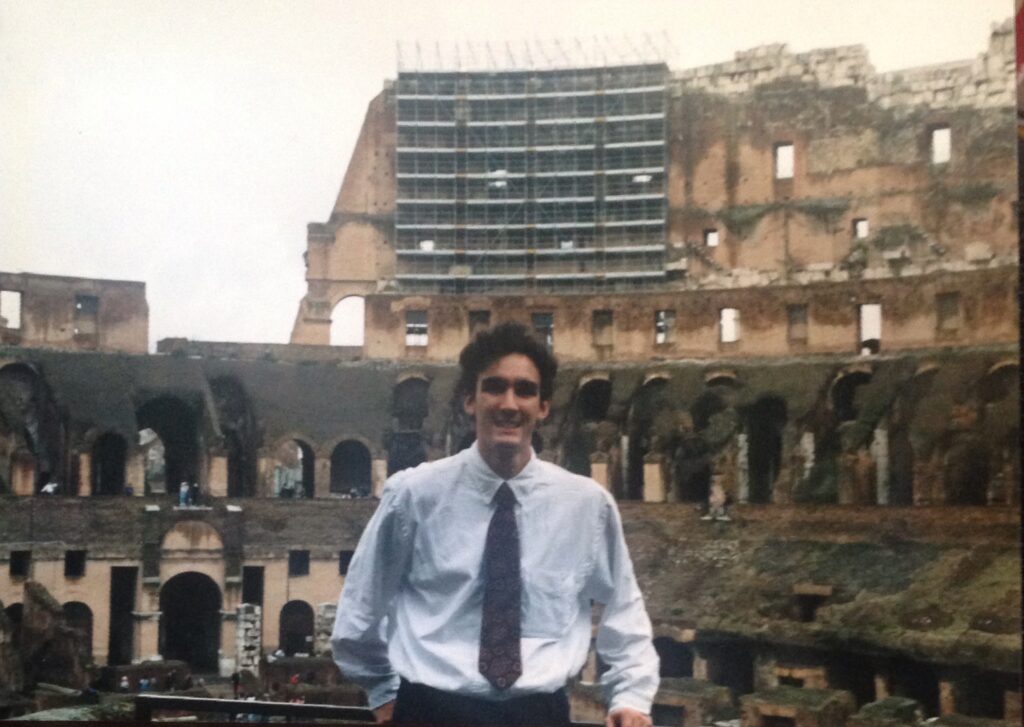
This month I am making my fourth and fifth visits to Rome. I was blessed to visit in 1997 and 2000 during and just after college, and then it was twenty-three years until I visited again in 2023. Now, this year, I am visiting again, for two days at the start of this month, and for five days at the end. A lot has changed across the span of time between my visits — mostly the differences are on my side, and not so much on the side of the eternal city. My own changes, of age, of religious vocation, and of ordination to the priesthood, just to name a few, have certainly affected what I went to see and how I saw what I saw.
1997. Regrets, I have a few, but especially my failure to get a haircut
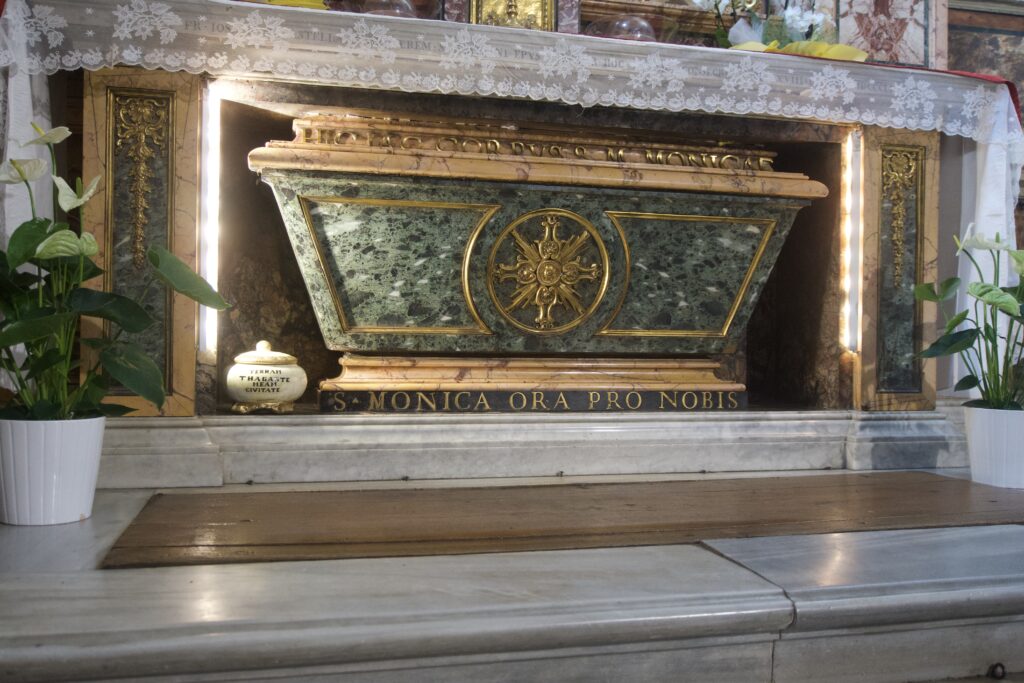
One Church I had never visited until this month is Sant’ Agostino, the Church of the Augustinian friars, of which our current Pope is a member. I love St. Augustine, but this time I was particularly seeking the bones of his mother, St. Monica. A friend had mentioned to me long ago how much she loved praying at Monica’s tomb, and then in the summer someone had reminded me that Monica was buried just around the corner from where I would be staying.
I found myself kneeling there on Sept. 4, just a few short days after Monica’s feast day, and lifting up all sorts of prayers, but especially asking for her intercession for my students. She, whose tears were heard on behalf of her son, she might lift up to God these young men and women whose journeys have ends that I cannot foresee.
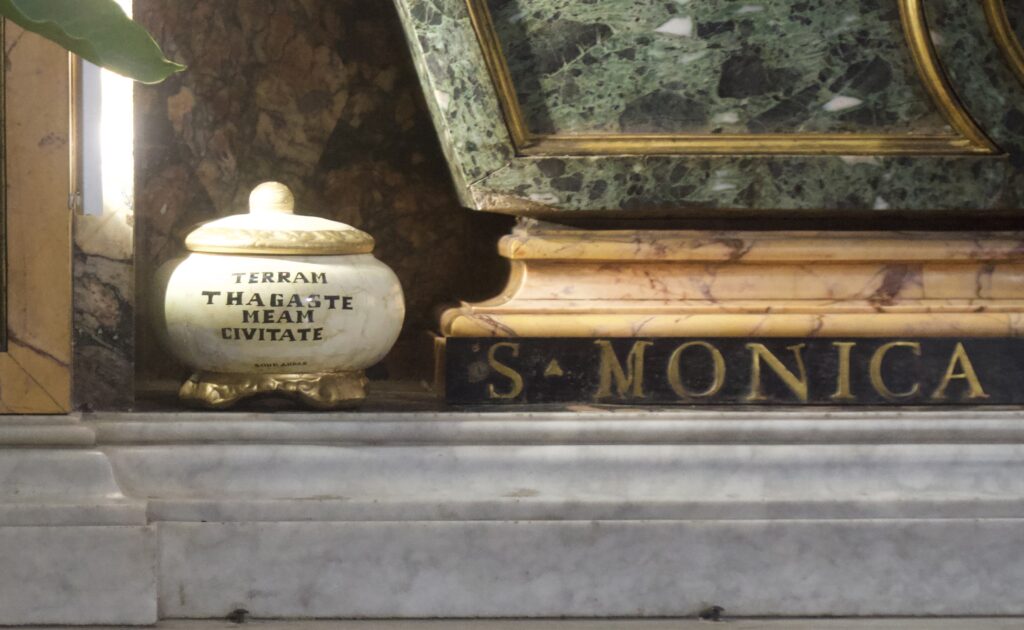
According to her son’s account, as she was dying in Italy, she did not see any need to be buried back in Africa where she had been born and raised. The only thing she asked was that her son would remember her at the altar of the Lord. It was all the more touching that her request to be remembered there was fulfilled in a literal way, since her bones now sit below a beautiful altar in the Church.1 Even so, in addition to this, she lies next to a jar of earth from her North African town, Thagaste. Her body did not return to the soil of Africa, but the soil of Africa was brought to her.
“Nor did she care if she had a tomb in her homeland. On that she gave us no instruction; she desired only that she might be remembered at your altar which she had attended every day without fail, where she knew that what is distributed is the holy victim who ‘abolished the account of debts which was reckoned against us’ (Col. 2: 14).” Augustine, Confessions, 9.13.36, trans. Chadwick. ↩︎
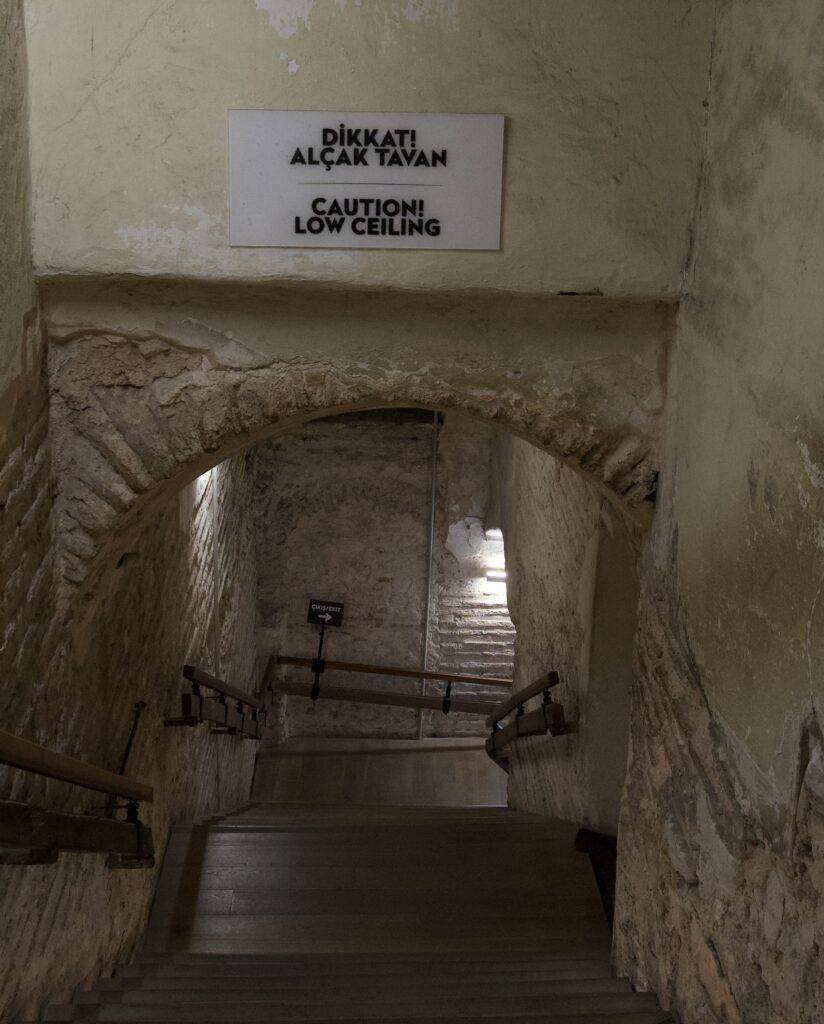
Since I have arrived in Europe, I have banged the top of my head on train ceilings, door lintels, boat portholes, and tunnel walls. I am a tall person, six-foot-three or so, and back home I am usually not very conscious of it, except in obvious places like basketball courts or airplane seats. In Europe these days, I have been forced to be conscious of it, through momentary pain and multiple scabs in my hair.
There has been an invitation concealed in my rather comical head-banging. It is an invitation to remember that these months are a spiritual journey, that, if it is to be genuinely Christian, has to involve an imitation of the Lord.
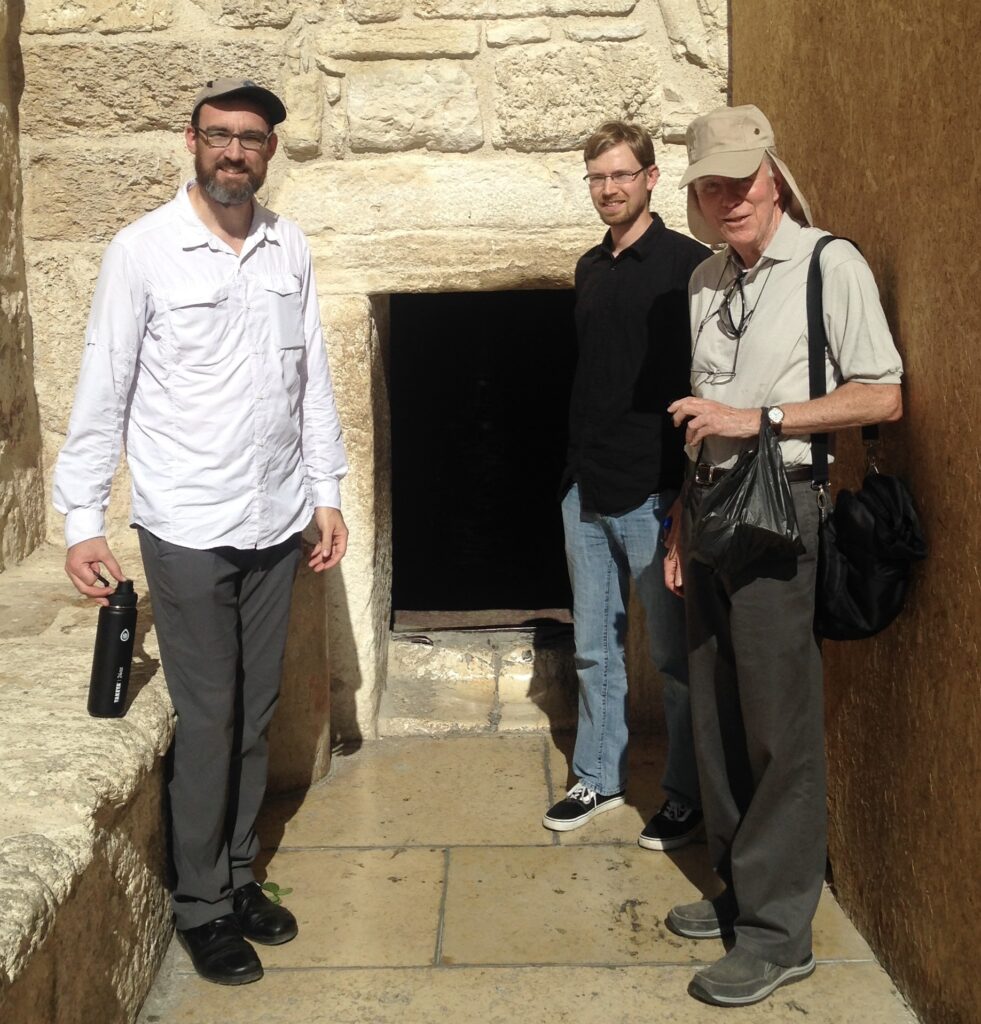
Entrance to the Church of the Nativity, 2017
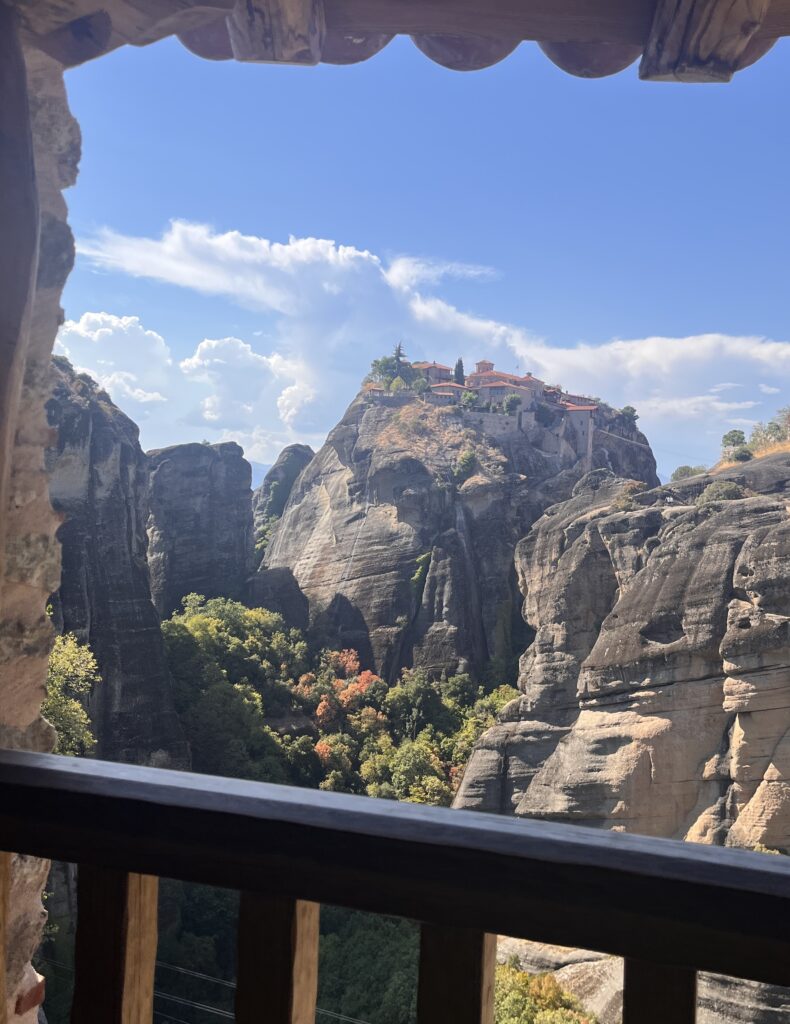
The doorway to the Church of the Nativity in Bethlehem is tiny. The entrance to the Holy Sepulcher in Jerusalem forces one to stoop. It does not seem an accident that the places where I have banged my head the hardest on this trip have been the monasteries of Mount Athos and of Meteora. Lower yourself: this is the way.
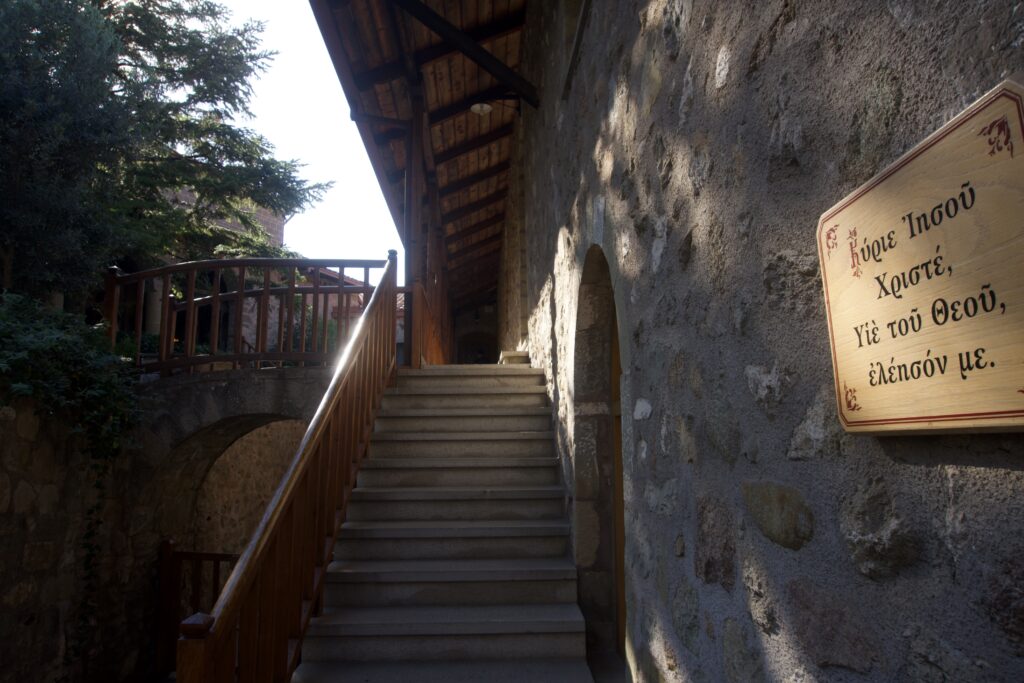
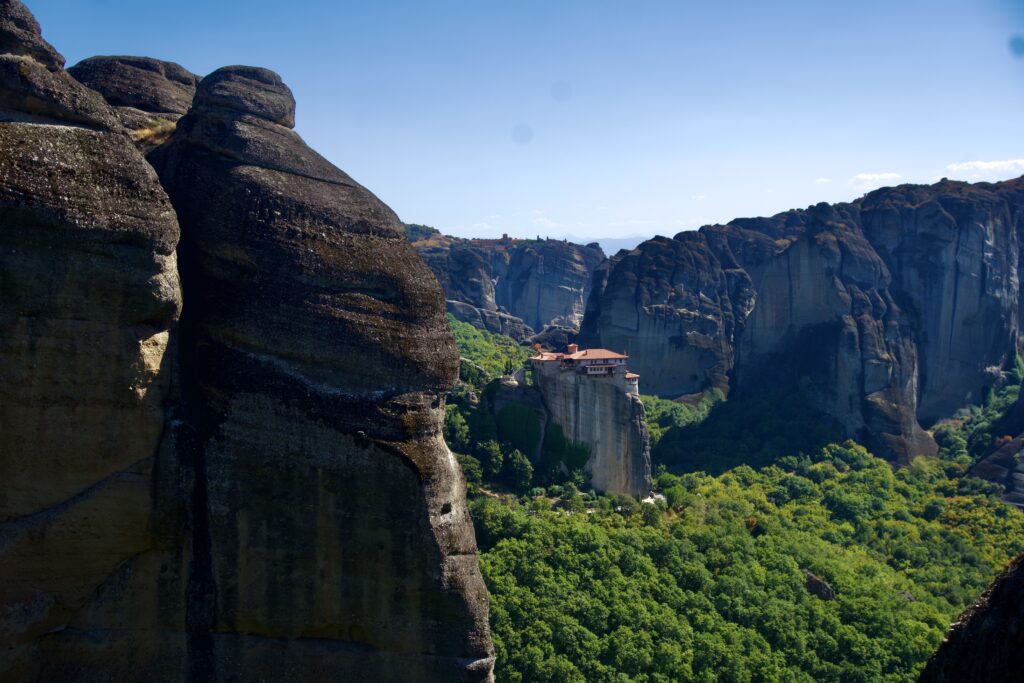
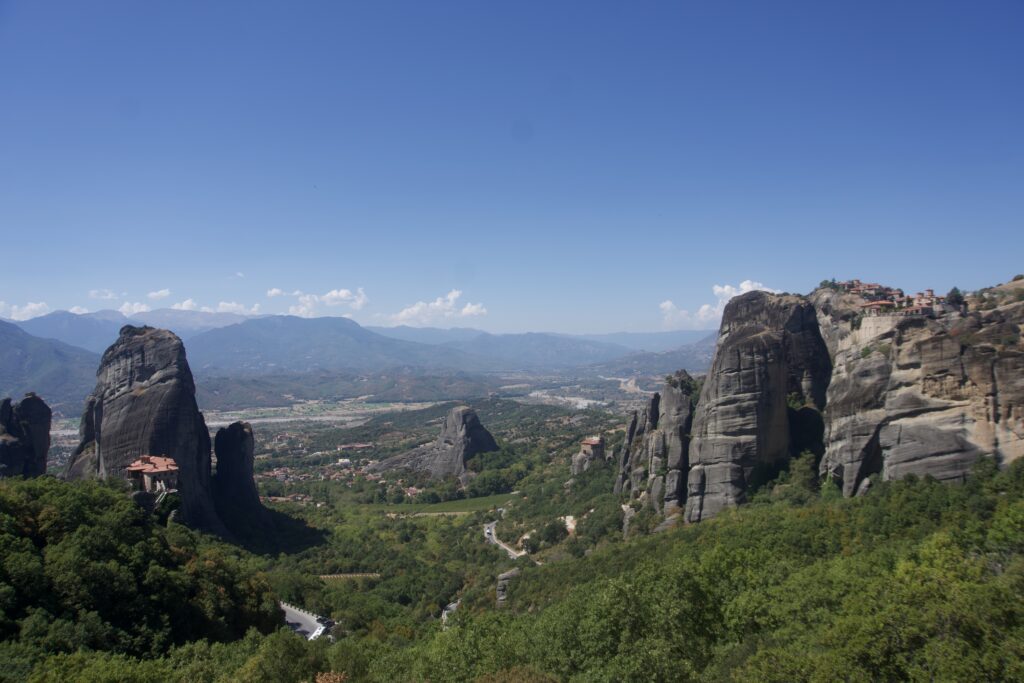
The ferry to Mt. Athos. I banged my head real hard on the doorway while I was disembarkingThe jetty at Simonopetra monasteryMeteoraSt Stephen’s, Meteora: “Lord Jesus Christ, Son of God, have mercy on me.”
The first ten days of my time away have involved many emotions and many challenges, but I can say without hesitation that the astonishing thing has been the generosity of my hosts. Symbols of how I have been received run through my mind: an oscillating fan brought to a hot room, a cup of Nescafé in a moment of exhaustion, a monastic parlor table bearing glasses of cranberry water, ouzo, and a bowl of candies. These symbolize for me something deeper, something that points me very directly to the love of God at the heart of our world. I have been allowed to see Christ in the people treating me (me!) as if I were Christ.
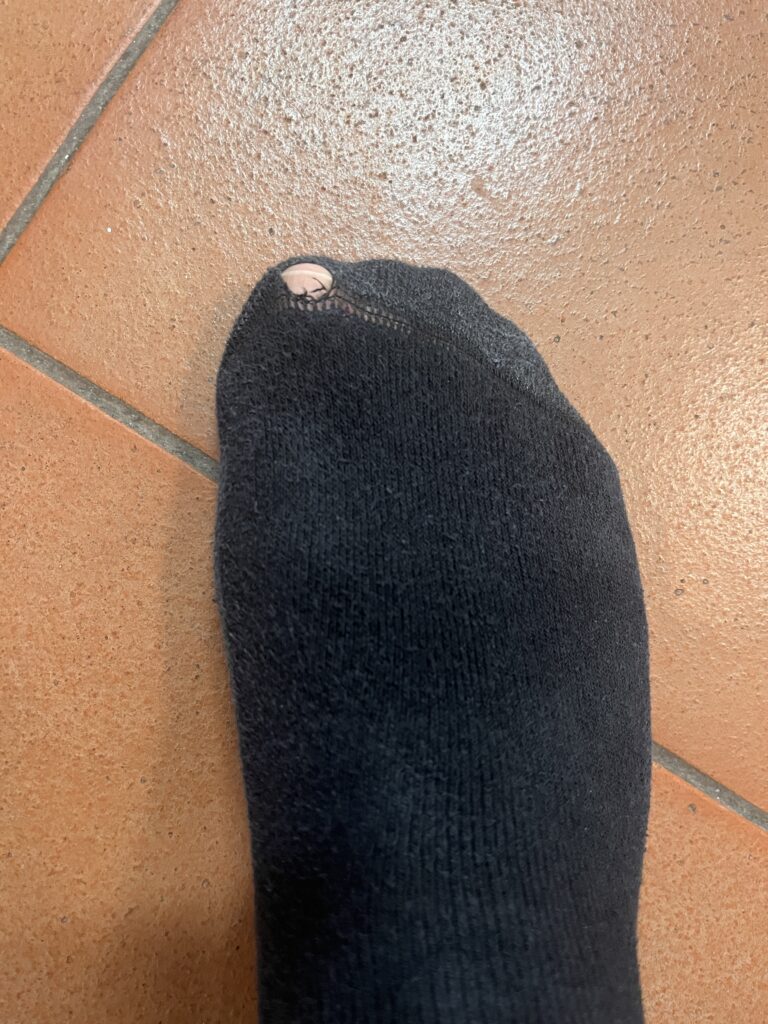
The assistance has been completely necessary. I took off my shoes when I arrived in Rome on Sep 3 and saw that one of my socks had already developed a big hole right in the toe. I’m falling apart already!
So far I have been in Rome, Greece, and now Istanbul. I will follow up with some vignettes over the next days, but I can share a couple quick photos here just to prove I am still alive. I cannot thank you enough for the prayers, which have sustained me.
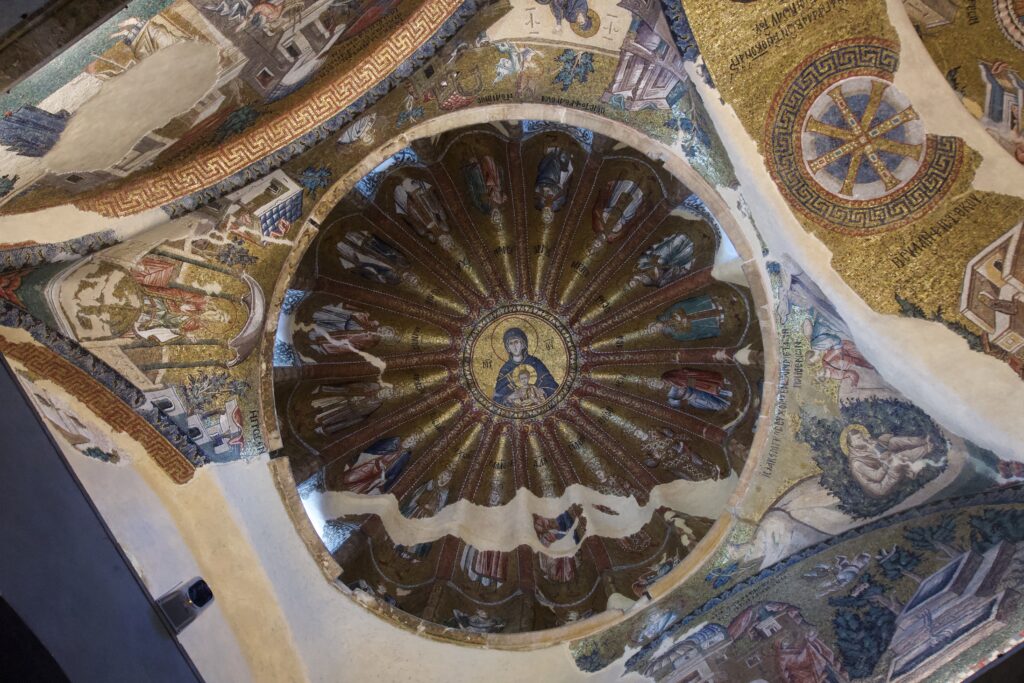
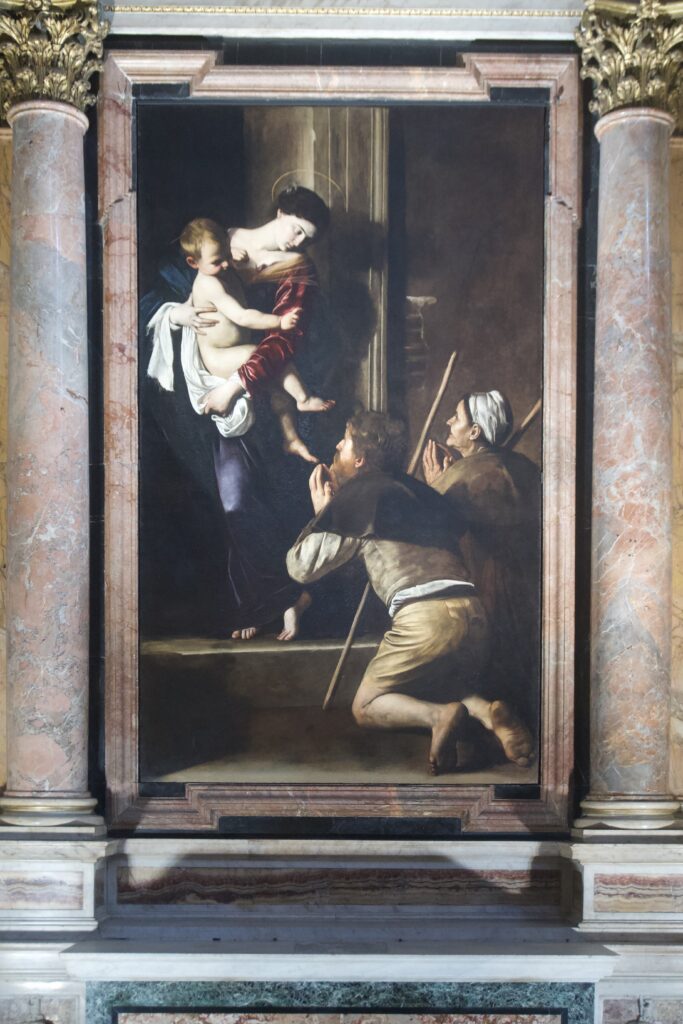
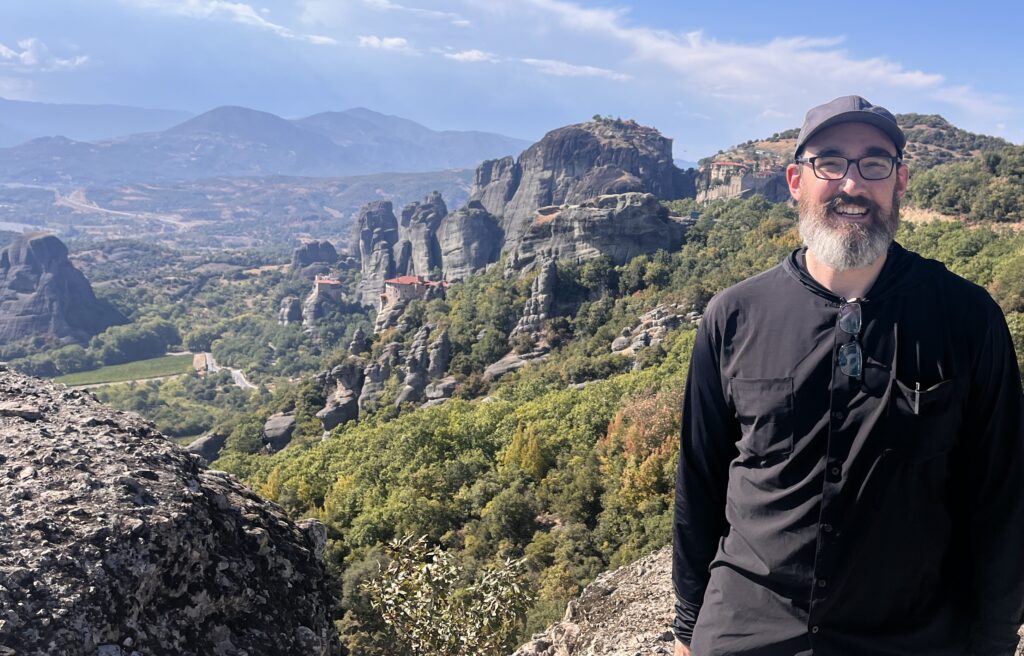
Chora Monastery (Kariye Mosque), Istanbul, one of the narthex domesCaravaggio, Madonna of LoretoI was looking for a different holinessMeteora Monasteries, Greece
As mentioned before, I have been very moved that so many people want to follow my wanderings this year. It has given me a renewed sense that God has provided this opportunity not just for me but for it to be shared with the Church and with the wider community. But I know myself: when I get busy with travel and other activities I find it hard to stay consistent with keeping in touch, and I imagine this will also be true with posting messages and photos to this blog. For that reason, I have now added an opportunity to sign up to receive posts via email. You can find how to sign up via the “newsletter” link in the menu at the top of the page or at the very bottom of the page. Or you can just click this link: newsletter. You can adjust your settings so that you receive it as soon as a post is published, or you can just get an email each week. That way, you do not have to keep checking this website; you can just wait for the posts to be delivered straight to your electronic doorstep.
Comments on the posts are turned off so that I do not have to moderate them. If you have a reaction or a comment, you can always send an email to mimagree AT jesuits DOT net. I cannot promise very frequent responses back, but I will certainly enjoy receiving feedback from you all.
I have a lot of gratitude to God for this anniversary of my entrance to the Society of Jesus. To all, both living and dead, who brought me to that day and sustained me through the years, my love and deepest thanks — most especially to my family and my brother Jesuits.
The work I am beginning in two weeks is a stage of Jesuit life called “Tertianship.”
For me, this stage happens to converge with a stage of academic life that is familiar: sabbatical. Normally, a sabbatical is designed for professors to take concentrated time for writing and researching in order to advance their subject and to enhance their teaching. In my case I am certainly using the sabbatical time to write and research, but that work will occur (indeed, has been occurring) mainly during the two summers around the school year. But the seven months running October 2026 through April 2027 I will spend on tertianship.
I will, no doubt, have a better idea of what tertianship involves during and after my experience of it. But I know enough to take the first step. Right now it is as if I am standing on a rock on the edge of an ocean. I can discern some lights blinking in the distance, over the rush of the waves I hear faint sounds of boats powering toward the horizon, and I feel drawn to head out into deep waters.
Formation
I am stepping away from the normal crush of work. There are expectations of my teaching and even my priestly ministry that occupy my mind and heart. I step away from those things, good as they are, to allow myself to be formed according to the graces and gifts that this Jesuit way of life offers. In some ways it will be like returning to the time when I first entered the Jesuits: I just heard today that the director of the program will be controlling how much money we have for personal expenses to ensure that we all have the same amount. It will be a newly tangible experience of the vow of poverty that I made 22 years ago last week.
I also do not know anyone in the group going into the experience. Just as when I entered the order, what binds us together are not the ordinary links of proximity and similarity but a sense of divine call. Human bonds will have to be built in the process of sharing this time together. A crucial piece of what is being formed through these facts is a sense of dependence on God and on the community.
Testing
St. Ignatius wanted repeated periods of testing built into Jesuit life. He trusted that God was showering down many graces on the world and particularly on the members of the Jesuits. But these graces would be noticed, recognized, and developed when they were tested. Through times of testing the Jesuit could savor the graces God had already given him, recognize the weaknesses for which he needed God’s pardon and aid, and see where God might best use his unique gifts in the future. Likewise, through testing, the Jesuits as a community could see their men even more clearly for who they are.
Preparation
The formation and the testing prepare for two related things. The more immediate preparation is for final vows. A Jesuit has to complete tertianship before the order will invite him to make his final profession of vows in the order. This solemn moment commits both the man and the community to one another in a complete way, and the community needs to form and test the man during tertianship before this deep commitment can be offered.
Part of those solemn vows, for Jesuits, is an even deeper commitment to obedience and to one’s mission in the order. The Jesuit motto is ad majorem Dei gloriam, for the greater glory of God. A Jesuit should not be sent where he can do a job that is merely good enough, but where his particular strengths and weaknesses can be used to advance God’s glory, to make God’s glory more evident.
So the preparation for final vows in the near-term is supposed to be also a preparation for a long-term goal of living ever more for the greater glory of God. The formation and the testing are designed to allow the Jesuit to be even more committed to this ideal and even more filled with realistic knowledge of God and of himself. Likewise, the formation and testing allow the community to send a Jesuit in the future with the community having clear confidence in his commitment to the goal of the order. We hope the community can then send him to a mission that makes use of his talents for the greatest unfolding of God’s plans that we can envision.
I will say more in another post about the particular components of tertianship, but, for now, it is enough to say that the crucial element in every tertianship comes from Jesus Christ. The most important thing a Jesuit can do at all times is to pray, and so the fundamental building block of tertianship is having more time to pray. In the flow of our busy work in many different sorts of institutions, it can be easy for Jesuits to let time for union with Christ be squeezed and compressed and reshaped by the obligations to the people we serve and, sadly, by our own egotism. This time of tertianship allows us to allow Christ to nudge out of the way anything that might have displaced him. He is the one thing necessary. May he be glorified forever.